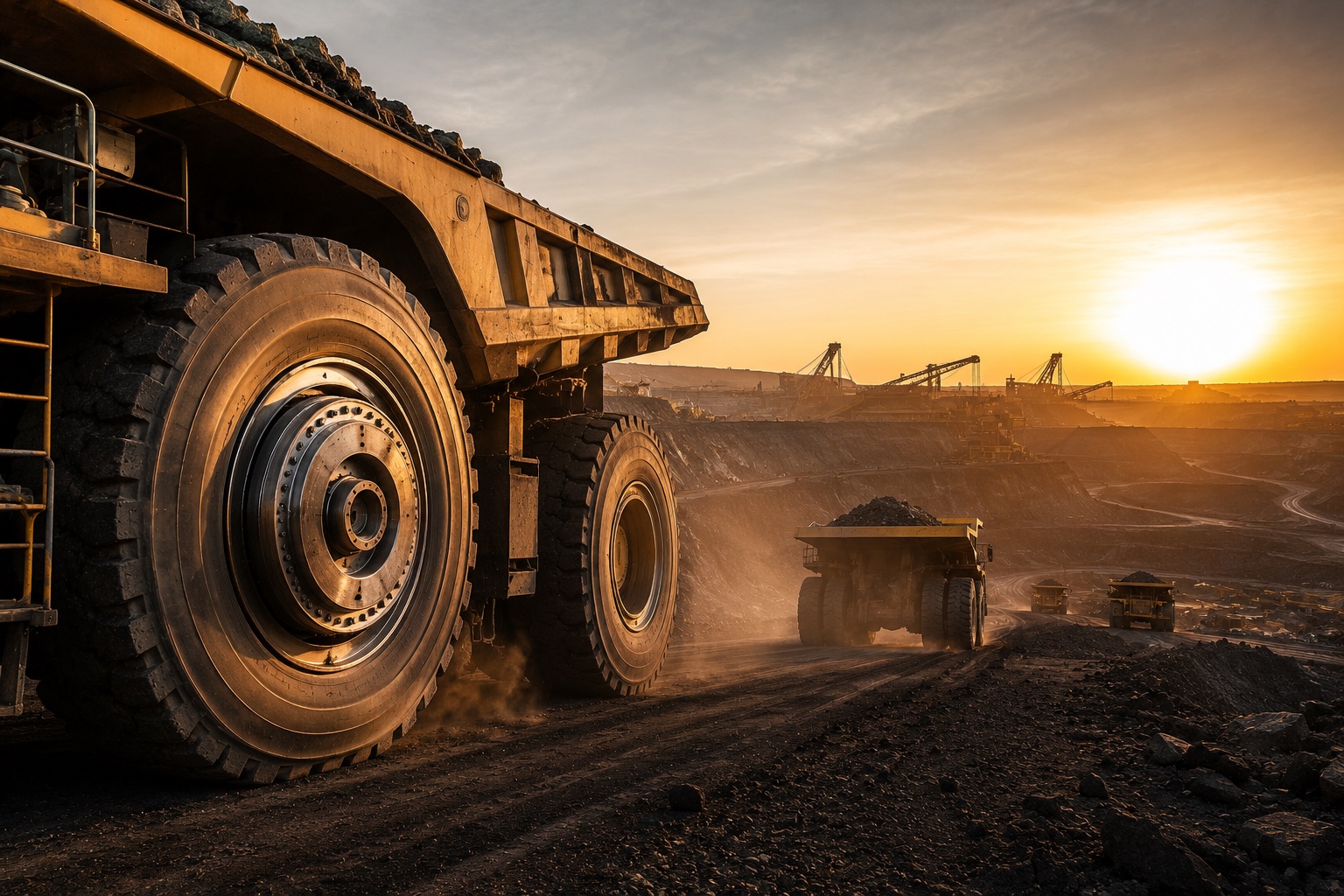
Keeping CIS Haul Fleets Rolling: The BelAZ Wheel-Supply Squeeze
When the established Western parts channels closed, the trucks did not stop. The question that defined the CIS mining market since has been simpler and harder: where does the next set of wheels come from?
Open-pit mining across the CIS region runs on a fleet that was, for two decades, dominated by a handful of global names. Before the supply landscape shifted, surveys of Russian open-pit operations counted on the order of 914 Komatsu units and 472 Caterpillar units in service — a dependency that looked unremarkable right up until the deliveries stopped. With Caterpillar halting shipments and Komatsu suspending exports from Japan, operators were left holding large fleets of capable machines and a shrinking pipeline for the consumable, wear, and structural parts that keep them productive.
Why wheels are the quiet pressure point
Engines and electronics get the headlines, but wheels and rims are where the supply squeeze bites in a way that is easy to underestimate. A haul-truck wheel is a structural, safety-critical, high-wear item with a finite fatigue life. Unlike a filter or a sensor, it cannot be stretched indefinitely by careful maintenance — once a rim base or lock ring reaches the end of its service window, it has to be replaced, and a multi-piece assembly that is run past its limit becomes a genuine hazard. That makes wheel supply non-negotiable in a way that few other parts categories are.
It is also a category where substitution is technically demanding. A wheel has to match the truck's hub interface, rated load, tire size, and the exact geometry of its bead seat and lock-ring groove. There is no approximate fit. This is precisely the kind of part that a market under supply pressure tends to get wrong first — and the consequences of getting it wrong are measured in damaged tires and stopped trucks.
BelAZ as the regional anchor
The natural pivot point for the region is BelAZ. Built in Zhodzina, Belarus, at a plant with more than sixty years in heavy machinery, the BelAZ range spans from 90-tonne quarry trucks such as the new 7558P up through the 360-tonne 7560 series and the symbolic 450-tonne 75710 — still the largest haul truck in production anywhere. For CIS operators, BelAZ offers something the Western OEMs no longer reliably can: a fleet and a parts chain that sit inside the region's own supply geography.
The first batch of 90-tonne BelAZ trucks entering service at a large Yakutian coal complex is a useful signal of the direction of travel. New iron is going into the ground from a regional manufacturer, and every new truck adds to an installed base that will need rims, rings, and bead seat bands for the rest of its working life. The wheel question does not go away with a new fleet — it simply shifts to whoever can supply qualified components for it.
A new truck does not solve the wheel problem. It relocates it to whoever can supply qualified parts for the next ten years.
Aftermarket and alternative supply grows up
The other half of the response has been the maturing of the alternative-supply market. The early reaction to the supply shock was improvisation — operators stockpiling parts and retaining the technicians who could keep older machines alive. That has since given way to something more structured: qualified manufacturers producing OEM-matched components to the original geometry and load ratings, rather than approximate copies. The distinction matters. An aftermarket built on reverse-engineered guesses erodes trust quickly; one built on proof-tested, dimensionally faithful parts can genuinely substitute for the original.
For a wheel specifically, "OEM-matched" has to mean more than a similar-looking profile. It means the rim base, lock ring, side ring, and bead seat band reproduce the original interfaces exactly, are forged from high-strength alloy rather than cast from inconsistent stock, and are proof-tested before they ship. Where that standard is met, an operator can run a Komatsu, Caterpillar, or BelAZ chassis on alternative-sourced wheels without compromising the load rating the truck was designed around.
What operators are optimizing for now
The lesson the region has absorbed is that resilience is a supply-chain property, not a brand. Fleets that came through the disruption best were the ones that diversified their wheel supply early, qualified alternative components against the original specifications, and kept the in-house expertise to inspect and rotate multi-piece assemblies correctly. The operators still struggling are the ones who treated wheels as a commodity to be sourced at the lowest price in a crisis — and discovered that a wheel that does not exactly match the chassis is not a saving at all.
The CIS haul-truck market is past the panic phase and into the rebuilding phase. The trucks kept rolling. The work now is making sure the wheels under them are sourced from manufacturers who treat the match between component and chassis as the whole point.
Kelios supplies OEM-matched rims and multi-piece components for Komatsu, Caterpillar, and BelAZ haul fleets — forged, proof-tested to 1.4× rated load, and warranted for the life of the chassis.
Find your fitment →