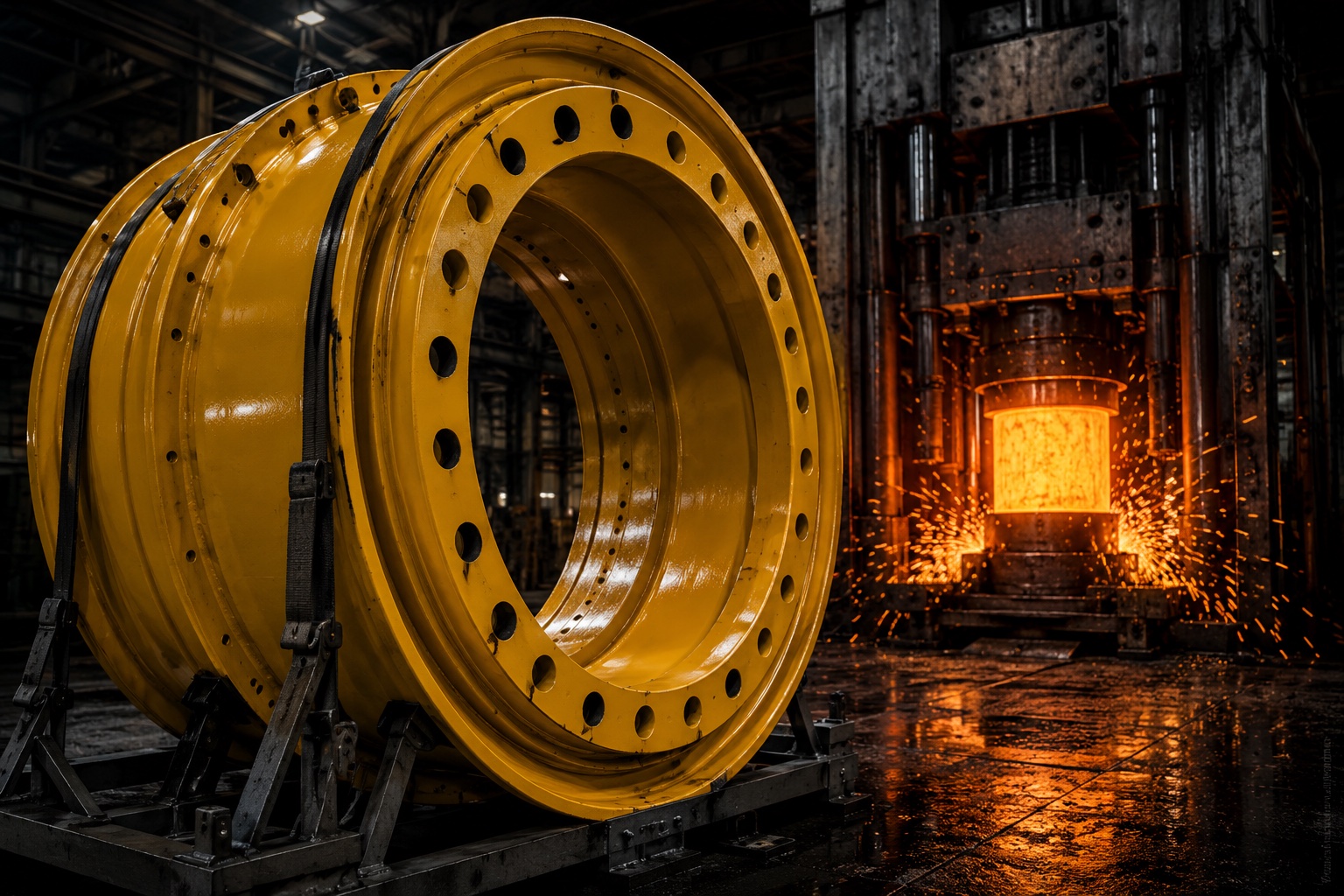
Forged vs. Cast: Why Grain Flow Decides the Life of a Mining Wheel
Two wheels can share the same alloy specification, the same diameter, and the same paint, and still differ in service life by a factor of three. The variable that separates them is not chemistry. It is how the metal was shaped.
On a surface-mining haul road, a wheel does not fail the way most people imagine. It rarely cracks from a single catastrophic overload. Instead it accumulates damage one cycle at a time — every rut, every berm, every loaded climb out of the pit adds a microscopic increment of fatigue. After tens of thousands of these cycles, a flaw that began invisibly small grows until the section can no longer carry its load. The wheel that survives longest is the one whose internal structure resists that crack from forming in the first place. That resistance is decided during manufacturing, long before the wheel ever sees a tire.
What forging actually does to metal
A cast wheel begins as molten metal poured into a mold. As it cools, the grain structure forms more or less at random, and the cooling process traps porosity — tiny voids and inclusions distributed unpredictably through the section. Each of those voids is a stress riser, a place where a fatigue crack can nucleate. The casting may meet its chemical specification perfectly and still carry the seeds of its own failure.
Forging takes solid billet and shapes it under enormous compressive force. Industrial wheel presses apply on the order of 13 million pounds of force, working the metal while it is hot enough to flow but never melted. Two things happen. First, the pressure closes internal porosity, consolidating the material into a dense, void-free section. Second — and this is the part that matters most — the deformation forces the grain to align with the contour of the part. Instead of a random crystalline structure, the finished wheel has a continuous grain flow that follows its load paths, the way the grain in a length of timber follows the trunk.
That aligned grain is what gives forged components their characteristic strength-to-weight ratio. A crack trying to propagate through the section must cut across the grain rather than running along a convenient boundary, and the dense, inclusion-free metal gives it nowhere easy to start. In repeated-impact service — exactly the duty cycle of an off-highway haul truck — this is why forged wheels are markedly less likely to crack or deform than cast or flow-formed equivalents.
Why the alloy spec is only half the story
High-strength alloys such as forged 7075-T6 are prized for their yield strength, but a specification on a data sheet describes the material, not the part. The same alloy, cast instead of forged, gives up much of its theoretical performance because the casting process never delivers the grain structure the alloy is capable of. This is the trap behind comparing wheels purely on their alloy name: the label can be identical while the fatigue life is not. When a cast rim takes repeated impacts on a haul road, deformation accumulates at the bead seat, the tire loses its seal, and replacement rates climb — not because the chemistry was wrong, but because the structure could not carry the cyclic load.
A spec sheet describes the metal. The forging process decides whether the wheel can use it.
The multi-piece reality of large wheels
There is a second reason forging matters specifically for mining wheels: their architecture. Ultra-class tires have bead thicknesses of roughly three to eight inches and cannot be mounted on a single-piece wheel without damage. So large off-the-road wheels are built as multi-piece assemblies — a rim base, a lock ring, a bead seat band, and one or more side rings or flanges. Each component carries its own share of the inflation and impact load, and each is a candidate for fatigue failure on its own.
The lock ring is the clearest example. Its job is to hold the tire bead firmly on the bead seat and keep it there under impact and pressure swings, while remaining detachable so the tire can be serviced. A lock ring that deforms or work-hardens unpredictably is both a service nuisance and a safety concern. Forging each ring and band — rather than casting or rolling from inconsistent stock — gives every piece in the stack the same dense, grain-aligned structure, so the assembly ages as a unit instead of failing at its weakest cast component.
What this means for total cost of ownership
The purchase price of a forged wheel is higher than a cast one. That is real, and it is the number that shows up first. But it is the wrong number to optimize. A mining wheel's true cost is dominated by what happens after it is fitted: unplanned changeouts, the tire damage that follows a seal failure, and the downtime of a truck that should have been hauling. A wheel that lasts 3.2× longer between failures does not merely save on replacement wheels — it removes interruptions from a haulage cycle where an idle ultra-class truck costs thousands of dollars an hour.
The right way to read a forged-versus-cast decision, then, is not as a price comparison but as a fatigue-life comparison. Proof-testing every wheel to 1.4× its rated load before it leaves the line confirms the forging did its job, and warranting the component for the life of the chassis it rides on aligns the manufacturer's risk with the operator's uptime. On a haul road, the cheapest wheel is almost never the one with the lowest sticker price.
Kelios forges every rim, ring, and band from high-strength alloy and proof-tests to 1.4× rated load. Explore the full component catalog — 44 OEM-matched variants across six product families.
View the catalog →