Specifying an OEM-Matched Wheel for Komatsu, Cat & BelAZ
A mining wheel is not a part you shop for. It is a part you specify. Get the five defining dimensions right and the wheel disappears into the truck the way it should. Get one wrong and you have bought a tire failure.
The temptation, especially under supply pressure, is to treat a haul-truck wheel like any other catalog item: find one with the right diameter, confirm it is in stock, order it. That approach works for a great many parts. It does not work for wheels, because a wheel sits at the intersection of three systems — the chassis hub, the tire, and the inflation pressure that ties them together — and it has to satisfy all three simultaneously. This guide walks through how to specify a replacement correctly for the three platforms that dominate CIS and global surface mining: Komatsu, Caterpillar, and BelAZ.
The five dimensions that define a fitment
Every correct wheel selection comes down to five interlocking properties. Diameter is the obvious one — surface-mining wheels commonly run in the 57-inch and 63-inch classes — but it is the least likely to be specified wrong. The dimensions that catch people out are the others.
The hub interface must match the chassis: bolt circle, pilot, and mounting-face geometry that locate the wheel concentrically and carry the drive and braking loads. The tire size and bead profile determine the rim width and the geometry of the bead seat the tire actually sits on. The rated load must meet or exceed the truck's per-wheel load at full payload, with margin — a 360-tonne 7560-series BelAZ imposes a very different per-wheel load than a 90-tonne quarry truck, even when the bolt pattern looks similar. And the lock-ring system — standard five-piece, Double Gutter Service, or Integral Gutter Lock Ring — has to match both the rim base groove and the operator's service practice.
Reading the multi-piece assembly correctly
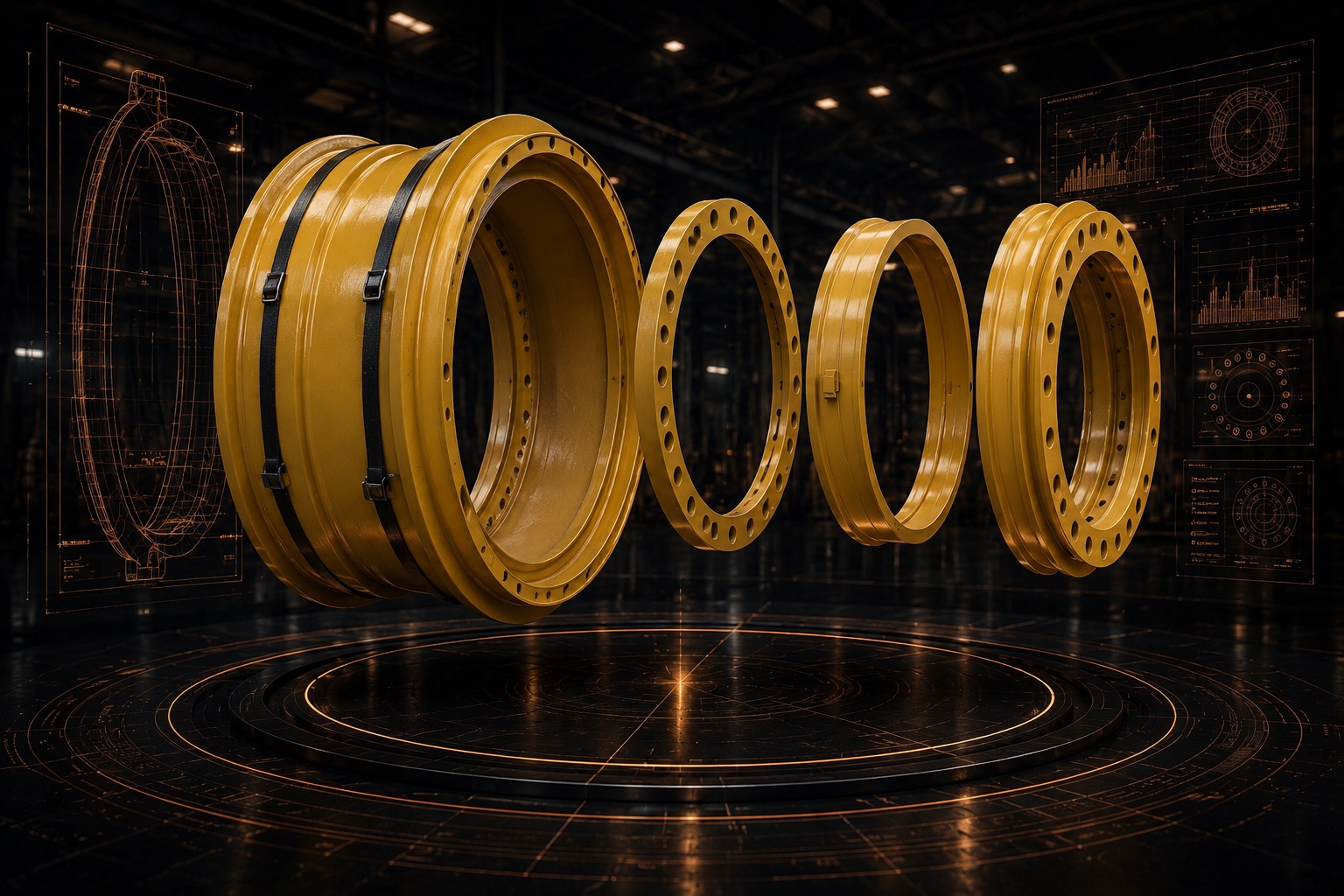
Because ultra-class tires cannot be mounted on a single-piece wheel, every large mining wheel is an assembly of separately specified parts: rim base, lock ring, bead seat band, and side ring or flange. The critical point for sourcing is that these are not interchangeable across families. A lock ring is machined to seat in a specific groove on a specific rim base; a bead seat band is profiled for a specific tire bead. You cannot mix a rim base from one fitment with a lock ring from another and expect the assembly to lock safely.
This is why a credible catalog organizes parts by component family — rims, rim base, lock ring, side ring, bead seat band, and discs — and ties each variant to the OEM platform it serves. When you specify a replacement, you are not picking a wheel; you are picking the correct member of each component family for your chassis, and confirming they belong to the same assembly. The part code does this work: a structured code that encodes the family and the fitment lets you order the exact piece rather than describing it and hoping.
You are not buying a wheel. You are buying the correct member of each component family for one specific chassis.
Platform notes: Komatsu, Caterpillar, BelAZ
For Komatsu fleets — the largest installed base across much of the CIS region — the priority is matching the wheel to the specific model in the 830E/930E-class lineage or the mechanical-drive ranges, because per-wheel loads and hub interfaces differ across the family. A wheel that fits one Komatsu model is not a universal Komatsu wheel.
For Caterpillar, the 793 and 797 classes set the reference points; the 797's per-wheel load is among the highest in surface mining, and its wheels demand the full rated-load margin and proof testing rather than a nominal match. For BelAZ, the spread is the widest of all — from 90-tonne quarry trucks through the 360-tonne 7560 series to the 450-tonne 75710 — so identifying the exact model and payload class before specifying anything is non-negotiable. The same manufacturer's name on two trucks tells you almost nothing about whether they share a wheel.
The qualification step most people skip
The final discipline is verification. An OEM-matched wheel should be more than dimensionally faithful — it should be forged rather than cast, so it carries the fatigue life the duty cycle demands, and it should be proof-tested to 1.4× its rated load before it is fitted, so you know the individual component, not just the design, can carry the load. Asking a supplier for proof-test documentation and warranty terms is the cheapest insurance available in the entire process. A wheel that is warranted for the life of the chassis it rides on tells you the manufacturer is confident in the match; a wheel sold with no test data and no warranty is asking you to absorb the risk yourself.
Specify the five dimensions, confirm the components belong to one assembly, insist on forged and proof-tested parts, and the OEM-matched wheel does exactly what a wheel should do — nothing noticeable at all, for the longest possible time.
Search the Kelios catalog by OEM, part code, or diameter — 44 OEM-matched variants across six forged product families, each proof-tested to 1.4× rated load.
Search by fitment →